December 1968 – October 1969 · four attacks
The Case
Seven people were attacked. Five died. What follows is the established record, with disputed points marked as disputed.
The people
They are listed first, and by name, because every other page on this site is about the man who did this to them.
David Arthur Faraday, 17, and Betty Lou Jensen, 16 — Lake Herman Road, Benicia, 20 December 1968. They were on a first date.
Darlene Elizabeth Ferrin, 22 — Blue Rock Springs Park, Vallejo, 5 July 1969. A waitress, married, with an infant daughter.
Cecelia Ann Shepard, 22 — Lake Berryessa, Napa County, attacked 27 September 1969, died 29 September without regaining consciousness.
Paul Lee Stine, 29 — Presidio Heights, San Francisco, 11 October 1969. A cab driver and a graduate student.
Michael Renault Mageau, 19 — shot at Blue Rock Springs and survived multiple surgeries.
Bryan Calvin Hartnell, 20 — stabbed six times at Lake Berryessa and survived. He later became a practising attorney.
The attacks
Lake Herman Road, Benicia — 20 December 1968
Faraday and Jensen parked in a turnout on a rural road after a school Christmas concert. A second car pulled in and stopped roughly ten feet away. Ten rounds were fired. Faraday was shot once behind the left ear beside the car; Jensen was hit five times in the back while running, and fell about 28 feet from the rear bumper.
Ten Winchester Western Super X .22 cases were recovered. There was no robbery and no sexual assault. Stella Medeiros found the bodies and flagged down Benicia police shortly after 11:20 pm.
Blue Rock Springs Park, Vallejo — 4–5 July 1969
Ferrin and Mageau were parked in a lot about two miles from the Lake Herman Road site. A car pulled in, left, then returned and parked behind them. The driver walked to the passenger window with a flashlight and, without speaking, fired five rounds from a 9mm. He walked away, heard Mageau moaning, and returned to fire again into each of them.
At 12:40 am a man called Vallejo police:
I want to report a double murder. If you will go one mile east to the public park on Columbus Parkway, you will find kids in a brown car. They were shot with a nine-millimetre Luger. I also killed those kids last year. Goodbye. Traced within minutes to a payphone at Joe's Union Station, Springs Road at Tuolumne Street. The frequently repeated claim that it came from a booth beside police headquarters is disputed and appears to originate with Robert Graysmith's book.
Lake Berryessa, Napa County — 27 September 1969
The only attack where the killer was seen at length. He approached Hartnell and Shepard wearing a square-topped black hood that draped over his chest, with clip-on sunglasses over the eye slits and a white crossed-circle symbol about three inches across on the bib. He carried a pistol and pre-cut plastic clothesline.
He told them he was an escaped convict from Deer Lodge Prison in Montana and needed money and their car. He had Shepard tie Hartnell, then re-tied her knots himself, then said he was going to stab them. Hartnell asked to be stabbed first so he would not have to watch. The attacker stabbed Hartnell six times and Shepard ten.
He then walked about 500 yards to their car and wrote on the door in black felt-tip: a crossed circle, then the dates of the two previous attacks, then Sept 27-69-6:30 · by knife.
Presidio Heights, San Francisco — 11 October 1969
Paul Stine picked up a fare and was shot in the head at Washington and Cherry Streets. The killer took Stine's wallet, keys, and a section of his bloodstained shirt. Teenagers across the street watched and called police.
The initial radio broadcast wrongly described the suspect as a Black man, though the witnesses had reported a white man. Minutes later, Officers Donald Fouke and Eric Zelms passed a white man walking east on Jackson Street and did not stop him. Fouke maintained for the rest of his life that they never spoke to the man, because the description they had been given did not match him. Zodiac's next letter claimed the officers “pulled a goof” and Zelms's widow later said her husband told her they had spoken to the man face to face. Zelms was killed on duty in January 1970 and never gave his own account. Disputed
The shirt fragment mattered enormously afterwards: Zodiac mailed pieces of it with later letters, which is how his authorship of those letters was confirmed.
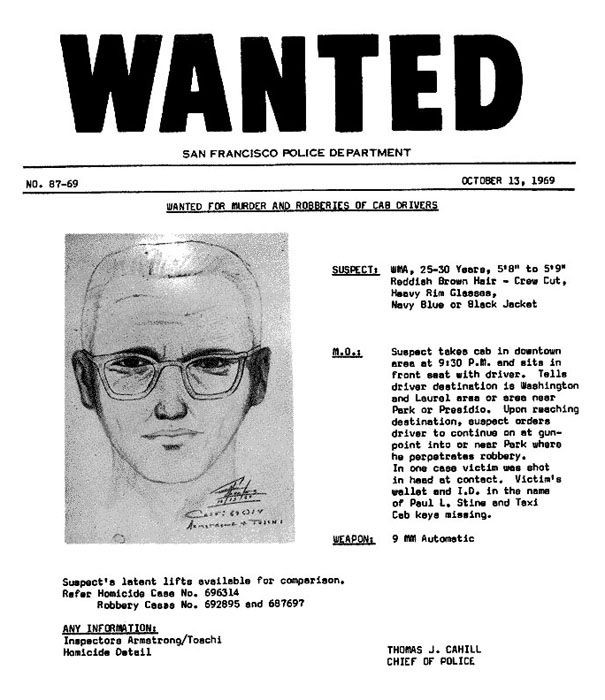
13 October 1969 · No. 87-69. One drawing. WANTED FOR MURDER AND ROBBERIES OF CAB DRIVERS — the department was working the killing as the last of a cab-robbery series, and the sheet lists two robbery case numbers beside the homicide. Suspect: WMA, 25–30 Years, 5′8″ to 5′9″, Reddish Brown Hair – Crew Cut, Heavy Rim Glasses, Navy Blue or Black Jacket.
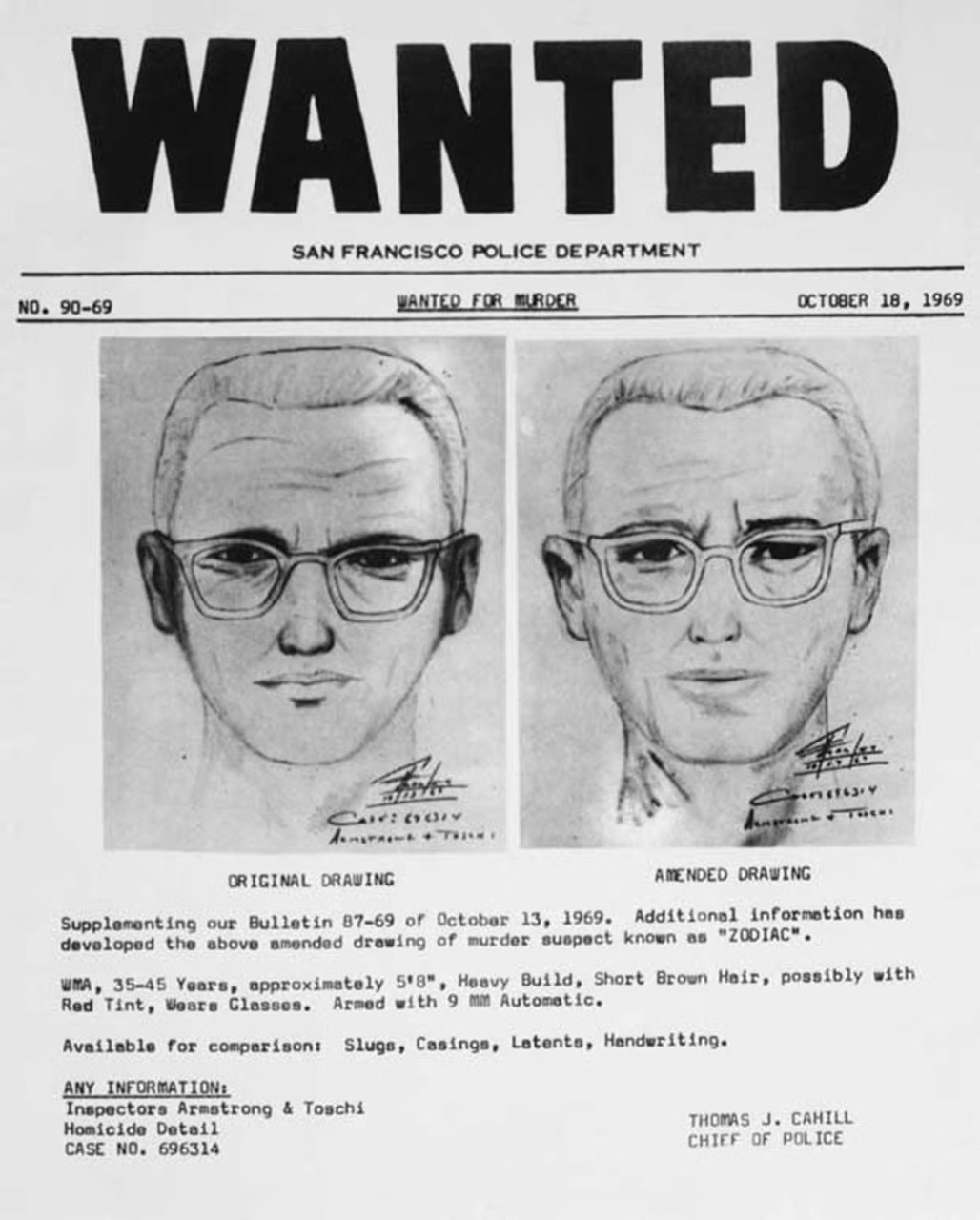
18 October 1969 · No. 90-69. Both drawings, printed together so the correction is visible. The cab-robbery framing is gone; the heading is now WANTED FOR MURDER alone. Suspect: WMA, 35–45 Years, approximately 5′8″, Heavy Build, Short Brown Hair, possibly with Red Tint, Wears Glasses.
Two things limit what the drawings are worth. The witnesses were teenagers watching at night from a house across the street, and the description they gave was garbled in transmission before it ever reached a sketch artist — the broadcast that went out named a Black man. Whatever the drawings capture, they capture it at second hand and at a distance, which is why this archive files them under description rather than identification.
The letters
The writing campaign ran far longer than the attacks. These are the mailings that matter most; the ones carrying ciphers are marked.
| Date | Item | Contents | Cipher |
|---|---|---|---|
| 31 Jul 1969 | Three letters | One third of a cipher to each of three newspapers, with details of the first two attacks only the killer could know, and a demand for front-page publication. | Z408 |
| 4 Aug 1969 | Examiner letter | First use of the phrase “This is the Zodiac speaking,” and the taunt that when they crack the cipher they will have him. | — |
| 8 Nov 1969 | Dripping Pen card | A greeting card carrying the 340-character cipher. Its stamp later yielded the partial DNA profile. | Z340 |
| 9 Nov 1969 | Seven-page letter | Details of the Stine murder, a diagram of a bomb intended for a school bus, and a scoreboard. | — |
| 20 Apr 1970 | “My name is” | Thirteen characters following the words “My name is —”. Almost certainly answering a public challenge from the American Cryptogram Association. | Z13 |
| 26 Jun 1970 | Button letter | A torn Phillips 66 road map with a crosshair over Mount Diablo, and a cipher said to locate a buried bomb. | Z32 |
| 26 Jul 1970 | Mikado letter | A parody of a Gilbert and Sullivan song, plus the only decryption hint he ever gave: the map code concerns radians and inches along the radians. | — |
| 27 Oct 1970 | Halloween card | Sent to reporter Paul Avery. Its diagonal-segment motif is retrospectively suspected of hinting at the Z340 transposition. | — |
| 29 Jan 1974 | Exorcist letter | A review of the film, and a final scoreboard. The last letter generally accepted as genuine. | — |
Several other letters attributed to Zodiac are of contested authorship. Where authentication rests on handwriting alone rather than on non-public case knowledge or shirt fragments, treat the attribution as unsettled.
Suspects
No one has ever been charged. Two names dominate public discussion, and neither survives contact with the physical evidence.
Arthur Leigh Allen
The suspect popularised by Robert Graysmith's book and the 2007 film. The circumstantial case was genuinely striking: an acquaintance reported Allen discussing killing couples and using the name Zodiac before the murders; he owned a Zodiac-brand watch bearing a crosshair logo; he lived near several scenes.
Against it: the partial DNA recovered from letter stamps did not match him, handwriting examiners excluded him, and the Stine fingerprints did not match. He died in 1992. Excluded on physical evidence
Gary Francis Poste
Named in 2021 by a private group calling itself the Case Breakers, on the basis of scar comparison and a claimed cipher decode. The FBI publicly restated that the case remains open and that the claim did not change its status; cryptanalysts who examined the claimed decode found it did not follow from the ciphertext. Not supported
Others
Lawrence Kane, Ross Sullivan, Richard Gaikowski, Earl Van Best Jr and Paul Doerr have each been advanced by particular researchers or authors. None has been tied to the crimes by physical evidence. The Ted Kaczynski theory, which circulated widely, is contradicted by his documented whereabouts.
One point from the cipher work bears directly here: none of these names fits Z13. Each was tested in multiple forms against the cipher's four equality constraints, and every one fails on length or on the pattern. See Findings.
Where the case stands
It is open at the FBI's San Francisco field office, the San Francisco Police Department, Vallejo Police, Napa County and Solano County Sheriffs' Offices, and the California Department of Justice.
No confirmed Zodiac DNA profile exists. The partial profile developed from letter stamps in 2002 is of limited quality and its provenance is debated, since the envelopes passed through many hands. Genetic genealogy, which broke the Golden State Killer case, needs a better sample than anything currently available.
The 1966 murder of Cheri Jo Bates in Riverside was investigated for years as a possible Zodiac crime. Riverside police formally de-linked it in August 2021 and handle it as a separate case.