Four cryptograms · 1969–1970
The Ciphers
Two were read. Two were not. The difference is almost entirely a matter of length.
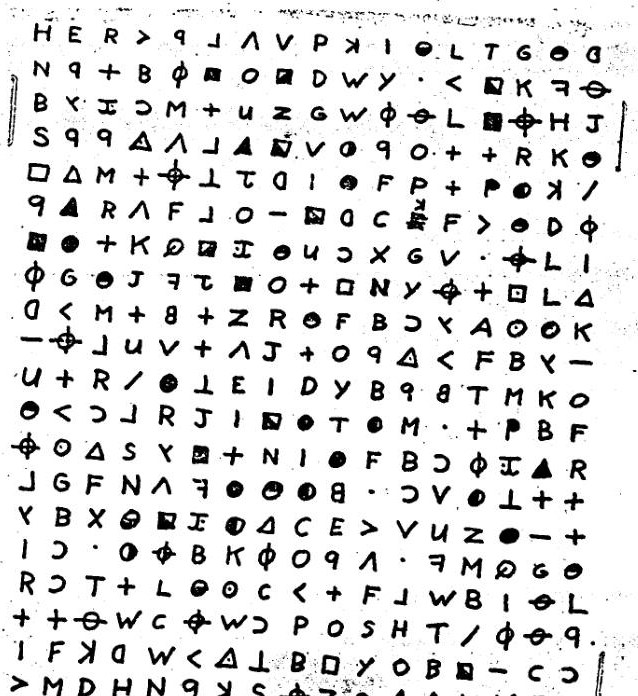
Hover, tap or tab through any grid below to highlight every occurrence of a symbol. Repeated symbols are the only places where a ciphertext constrains its plaintext, which is why the counts in the table matter more than they look.
| Cipher | Mailed | Length | Distinct symbols | Multiplicity | Status |
|---|---|---|---|---|---|
| Z408 | 31 Jul 1969 | 408 | 54 | 0.132 | Solved 1969 |
| Z340 | 8 Nov 1969 | 340 | 63 | 0.185 | Solved 2020 |
| Z13 | 20 Apr 1970 | 13 | 8 | 0.615 | Unsolved |
| Z32 | 26 Jun 1970 | 32 | 29 | 0.906 | Unsolved |
Multiplicity is distinct symbols divided by length. Below roughly 0.20 a homophonic cipher is generally solvable with modern hill-climbing. Z13 and Z32 sit far above that line, and no amount of computing power moves them across it.
Mailed 31 July 1969 · solved August 1969
Z408 — the one he wanted read
Mailed in three parts on 31 July 1969, one to each of three newspapers, with the demand that they be printed on the front page. Zodiac wrote that the cipher contained his identity. It did not.
Donald and Bettye Harden of Salinas broke it within about a week using pencil and paper. Bettye Harden supplied the two cribs that opened it: that a man this eager for attention would begin with the word I, and that the text would contain KILL. The break came from a structural mistake — Zodiac did not rotate his three symbols for L, so the doubled L in KILL produced literally repeated pairs in the ciphertext.
I LIKE KILLING PEOPLE BECAUSE IT IS SO MUCH FUN IT IS MORE FUN THAN KILLING WILD GAME IN THE FORREST BECAUSE MAN IS THE MOAT DANGERTUE ANAMAL OF ALL Opening of the Z408 plaintext, misspellings original. Toggle the grid above to read the whole text in place.
The last eighteen characters, EBEORIETEMETHHPITI, have never made sense. They are usually read as filler used to pad the message out to exactly 408 characters, though nobody can prove that.
Mailed 8 November 1969 · solved December 2020
Z340 — fifty-one years
Mailed on 8 November 1969 on a greeting card. It resisted every attack for fifty-one years, largely because it is not a pure substitution cipher: the plaintext was written into a grid and then read out diagonally before being enciphered.
David Oranchak, Sam Blake and Jarl Van Eycke broke it in December 2020. Blake generated roughly 650,000 candidate transposition schemes; Van Eycke's AZdecrypt hill-climber attacked the substitution layer of each. The winning scheme reads the grid in a period-19 diagonal, one down and two across, in three sections. Zodiac made two errors doing it, which is part of why it held out so long.
I HOPE YOU ARE HAVING LOTS OF FAN IN TRYING TO CATCH ME … I AM NOT AFRAID OF THE GAS CHAMBER BECAASE IT WILL SEND ME TO PARADLCE ALL THE SOOHER From the Z340 plaintext. The mangled words are in the original and include Zodiac's own encipherment slips.
The message answers a television appearance: a caller to a 22 October 1969 talk show claiming to be Zodiac. It was not him, and the cipher says so — THAT WASNT ME ON THE TV SHOW. Crucially, it contains no name and no new information about the crimes.
Mailed 20 April 1970 · unsolved
Z13 — “My name is”
Mailed 20 April 1970, directly after the words My name is —. It is almost certainly an answer to Dr. D. C. B. Marsh, president of the American Cryptogram Association, who had publicly dared Zodiac to send a cipher that genuinely contained his name.
Thirteen characters, eight distinct symbols. The repeated symbols force four equalities on any candidate plaintext: positions 1 and 12 must share a letter, so must 3 and 11, so must 8 and 13, and positions 5, 7 and 9 must all be the same letter. That is the entire constraint set. Everything else is unconstrained.
Two of its eight symbols appear in no other Zodiac cipher: a circled figure at positions 5, 7 and 9, and an anchor shape at position 10. The anchor also appears in Z32 and nowhere else, which invites the theory that the two 1970 ciphers share a key. We tested that theory and it does not survive — see Findings.
The visual reading A E N … N A M is what drives the famous “Alfred E. Neuman” proposal and the observation that the last three glyphs spell MAN backwards. It is worth knowing that across both solved ciphers only 4 of 73 letter-shaped symbols stood for their own letter — about 5 per cent. Zodiac's own practice argues against reading those glyphs at face value.
Mailed 26 June 1970 · unsolved
Z32 — the map code
Mailed 26 June 1970 with a torn Phillips 66 road map of the Bay Area. A crosshair was drawn over Mount Diablo and marked 0, 3, 6, 9 clockwise, with a note that 0 was to be set to magnetic north. The letter said the map and the code together would show where a bomb was set.
A month later he added the only hint he ever gave: The Mt. Diablo Code concerns Radians & # inches along the radians. Dividing the circle into the twelve units his own markings imply makes one of his “radians” thirty degrees rather than the mathematical 57.3.
No bomb was ever found.
Thirty-two characters, twenty-nine of them distinct. Only three symbols repeat at all. Because there are more distinct symbols than letters in the alphabet, Z32 cannot be a one-to-one substitution cipher — that is pigeonhole arithmetic, and it rules out an entire category of proposed solutions on sight.
What remains is a homophonic cipher whose ciphertext constrains its plaintext in exactly three places. Scanning ordinary English prose turns up a perfect fit roughly once every 3,600 letters. That is the real reason it is unread.